Research
Past and Current Research
If I had only one line to summarize my past and current research, I would describe myself as a geophysicist focused on measuring, mapping, and understanding the diverse magnetic fields encountered in Earth’s environment and in near-Earth-like planets’ space. Over the course of my career, I have concentrated on several key areas of research:
- Measuring Earth’s Magnetic Field: I have been actively involved in global efforts to measure and monitor the Earth’s magnetic field, employing a wide range of techniques—from ground-based observations to satellite missions.
- Core Magnetic Field and Temporal Variations: A significant part of my work has been dedicated to modeling the Earth’s core magnetic field and its temporal variations. I have focused on phenomena like geomagnetic jerks and studied the various contributions to the magnetic field, including those from the lithosphere and external sources like the ionosphere and magnetosphere.
- Deep Earth Properties: I have utilized geomagnetic data to infer physical properties of the Earth’s deep interior, particularly investigating the conductivity of the lower mantle and the dynamics of fluid motion at the core-mantle boundary. These studies contribute to a better understanding of the processes governing Earth’s interior.
- Planetary Magnetism: I have long considered that Earth’s magnetism should be studied within the broader context of planetary magnetism. This perspective has fueled my interest in the magnetic fields of other planets, such as Mars, Mercury, and Venus, and has guided my research in planetary science and comparative geophysics.
- Gravity Fields and Broader Geophysical Studies: While magnetic fields have been the core focus of my research, I have also explored other geophysical domains, particularly gravity fields. This multidisciplinary approach broadens our understanding of planetary interiors and contributes to the wider field of geophysics. Solid Earth and Space Observations: As a geophysicist, I am deeply interested in the use of space-based observation techniques to study the Solid Earth. This encompasses not only magnetic fields but also gravity and other parameters critical to understanding the dynamics of the Earth and other planetary bodies.
In my view, science is more than just a profession—it’s a passion and a hobby that must be shared with others. I have always sought to pass on my knowledge, guiding students through internships and PhD projects, many of whom have gone on to successful careers. I take great pride in their achievements and enjoy continuing to engage with them as colleagues and collaborators in the field of geophysics.
Moreover, I believe it is our duty as scientists to contribute to the well-being of the scientific community. Throughout my career, I have been involved in a variety of activities aimed at advancing the field of geophysics and supporting the broader scientific community, whether through public outreach, collaboration, or service in scientific organizations.
MEASURING THE MAGNETIC FIELD
My work focuses on understanding why we invest so much effort in measuring Earth’s magnetic field, emphasizing its unique ability to provide a long-term record and to reveal contributions from multiple internal and external sources. By recovering ancient magnetic data, maintaining observatory networks, and conducting field campaigns and satellite studies, I help document how Earth’s magnetic field varies across time and space. These efforts support a global understanding of geomagnetic processes and their technological impacts, while also inspiring my interest in magnetic fields across other planets.
MODELLING THE GEOMAGNETIC FIELD AND ITS VARIATIONS
I focus on modelling Earth’s magnetic field and its many sources, contributing to global models such as IGRF, CHAOS, and GRIMM, as well as developing wavelet-based methods to capture complex spatial patterns. Using data from satellites and observatories, I analyse geomagnetic jerks, regional core field changes, and high-resolution crustal anomalies, including contributions to the WDMAM map. These studies help reveal how magnetic signals from the core, crust, and space weather interact across multiple scales, deepening our understanding of Earth’s dynamic magnetic environment.
PHYSICAL PROPERTIES OF THE DEEP EARTH'S INTERIOR
My work on Earth’s interior includes interpreting geomagnetic jerks as signals shaped by mantle conductivity, which allowed me to estimate the mantle’s electrical properties. I also map fluid flows at the core–mantle boundary over the past four centuries, revealing long-lasting patterns and rapid accelerations detected by satellite observations. These results show that geomagnetic jerks, torsional oscillations, and core–mantle coupling are interconnected processes within Earth’s deep interior.
PLANETARY MAGNETIC FIELDS
Mars lacks an active core-generated magnetic field and instead shows strong crustal magnetization, whereas Mercury possesses a weak global field likely driven by its core. Space missions such as MGS, MESSENGER, and BepiColombo have revealed major contrasts in the origin, strength, and structure of these planetary magnetic fields. Understanding these differences provides key insights into planetary interiors, dynamo evolution, and interactions with the solar wind.
GRAVITY FIELD
To better understand Earth’s deep interior, I use satellite gravimetry from the GRACE, GRACE-FO, and GOCE missions. This work has shown that core flows can generate detectable gravity signals, and it includes contributions to GOCE analyses of three-dimensional gravity variations. Combining these results with other geophysical data helps me build a more integrated view of Earth’s internal dynamics.
SOLID EARTH SEEN FROM SPACE
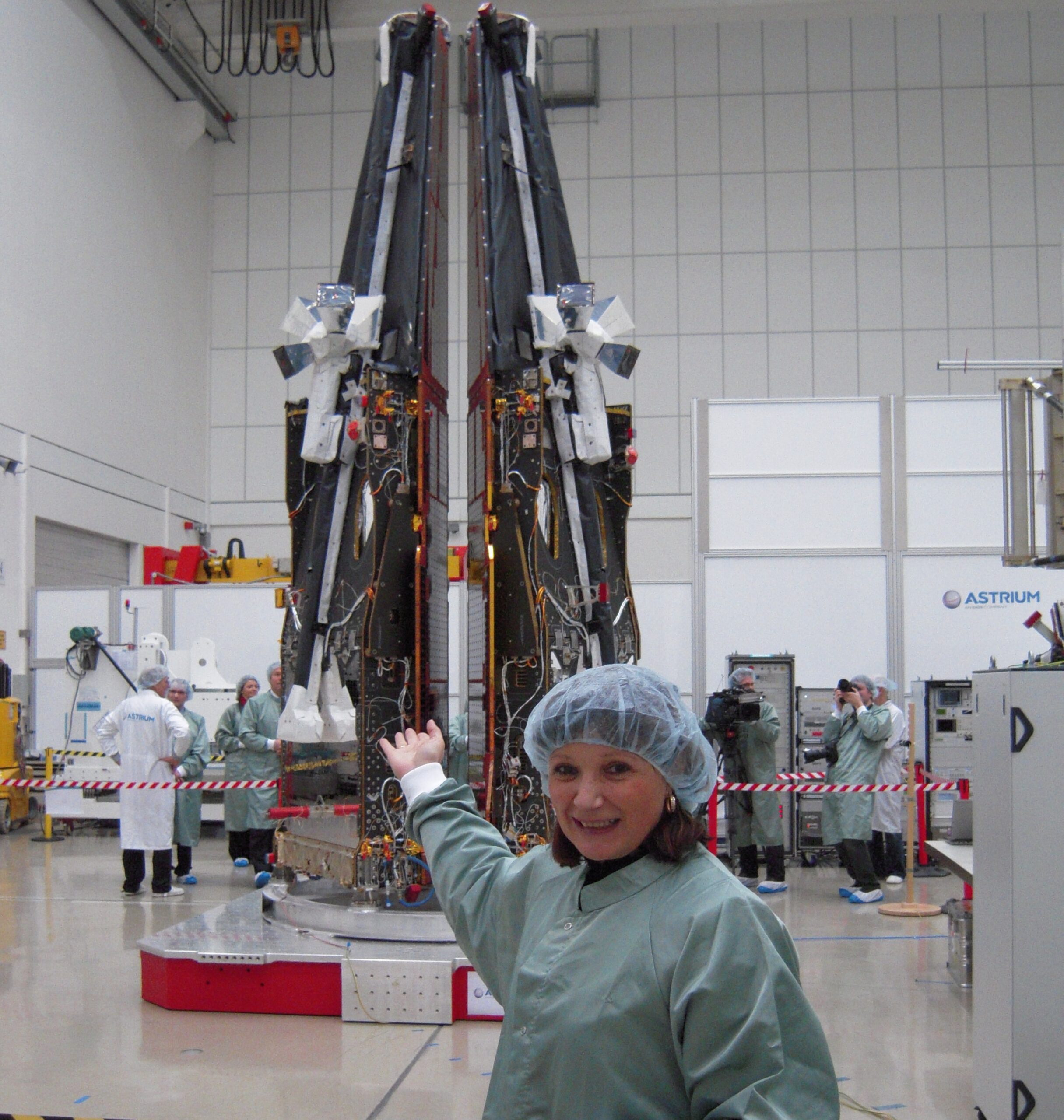
My work on the Solid Earth focuses on ensuring continuity of key geophysical observations to better understand internal processes and their surface expressions. I contribute to ESA’s Swarm mission and to gravity studies using GRACE, GRACE-FO, and GOCE, while also collaborating with French teams on geodesy, DORIS/ITRF, LIDAR, and hyperspectral imaging. By combining these space-based and ground-based datasets, I aim to broaden and strengthen research on Earth’s dynamic interior.